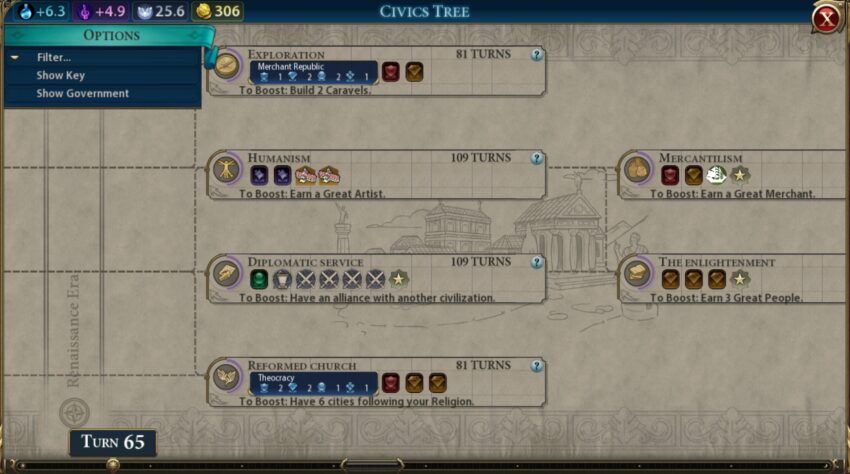

Military Policies
Press Gangs
100% Production toward Industrial era and earlier naval units.
Made obsolete by:
- International Waters
Required Civics:
- Exploration
Impressment was the practice of “recruiting” men into the navy by force (with or usually without notice). Navies of several civilizations used press gangs (armed groups who wandered about and did the “impressing”), but the most well-known was the Royal British Navy, who began using it during wartime in 1664 AD and continued until the Napoleonic Wars.
Although the practice fell into disuse after 1814 (impressed sailors did not necessarily make good sailors), it wasn’t outlawed in Great Britain until 1835. Despite lurid tales, press gangs rarely operated outside ports and rarely took anyone but seafarers, longshoremen, and fishermen – anyone not accustomed to the sea tended to die too quickly.
Wars of Religion
+4 Combat Strength when a non-religious unit fights a civilization that follows another Religion.
Required Civics:
- Reformed Church
One thing is guaranteed about the faithful: their willingness to kill (or die) for their beliefs. Since the ancient Mesopotamian city-states began bashing each other, religion has been the cause of many a “holy” war – the Israelite conquest of the Canaan city-states, Muslim expansion, and the subsequent Crusades.
But none matched the wars of religion that were set off when Luther nailed up his 95 theses. For much of the 16th and 17th centuries, the Protestants and Catholics went at each other with abandon, devastating most of Central Europe and causing astronomical casualties – an estimated 11.5 million in the Thirty Years War and another four million in the French Wars of Religion alone.
Logistics
+1 Movement if starting turn in friendly territory.
Required Civics:
- Mercantilism
In the late 16th Century AD, the size of armies in Europe increased dramatically, and forces of 100 thousand were not unheard of (although these reported numbers may have included the horde of camp followers as well).
Given the state of transport and roads in the Renaissance, in general when operating in enemy territory an army would forage (i.e., pillage) to maintain itself. But this didn’t supply much that was now necessary – munitions, siege guns, uniforms, medical supplies, booze, and all the other things that keep soldiers content.
Thus, the baggage trains that attended armies grew; during the Thirty Years War for some mercenary armies this amounted to a wagon for every 15 men.

Economic Policies
Colonial Offices
+15% faster growth for cities not on your original Capital’s continent.
Required Civics:
- Exploration
Once national governments began taking a hand in (and taking over) overseas colonies founded by trading companies, military adventurers, and religious fanatics, the ad hoc administrations of such distant outposts needed a firmer hand. Thus, the Spanish formed colonial offices, and were soon emulated by the other colonial powers.
In the late-1500s AD the Spanish monarchy formed the Council of the Indies (although it didn’t assume its final form until a century had passed), a hierarchical organization to rule over the colonies since the king couldn’t be bothered.
Initially two viceroyalties were established (two others later); Spanish viceroys had judicial and legislative control of their territory, and more importantly – had direct access to the colonial treasury.
Religious Orders
All Religious units +5 Religious Strength in theological combat.
Required Civics:
- Reformed Church
Although the Buddhists (Zen, Shaolin) and Muslims (the various Sufi tariqa) have religious orders of a sort, it was Catholicism that spawned the most famous. In the Catholic Church, founding a religious order must be consecrated by the Pope… it can’t be done on a whim.
The earliest that would be recognizable today was the founding of the Order of St. Augustine c. 1244 AD, cobbled together from several earlier mendicant orders of friars. By the time of the Renaissance, all sorts of holy orders were being created: Benedictines, Carmelites, Dominicans, Franciscans, Jesuits, and so forth and so on.
And a number of religious orders concerned more with eliminating heathens than saving souls arose during the Crusades, such as the Knights Templar and Knights Hospitaller.
Simultaneum
Doubles Faith yield from Holy Site district buildings.
Required Civics:
- Reformed Church
In the wake of the Protestant Reformation, and the mishmash of denominations across Germany, arose the ‘simultaneum mixtum’ (or Simultankirche), a church in which two or more differing groups (Lutheran, Congregational, Calvinist, and so forth) practice services. Each denomination worshiped at different times and with different clergy, and tolerated the other faiths sharing their space.
Although, given its tenets as the “true church” (and all the bloodshed of the religious wars), Roman Catholicism did not generally engage in simultaneum… although a Catholic and Evangelical one operated for some 200 years until 1850 AD in Goldenstedt.
Triangular Trade
+4 Gold and +1 Faith from all Trade Routes.
Made obsolete by:
- Ecommerce
Required Civics:
- Mercantilism
Triangular trade routes are those that connect three locations, each with a different commodity desired in one of the other two, in a profitable cycle of merchant voyages. As the colonial empires grew, shipping captains sought to make their trips across the Atlantic Ocean ever more efficient.
One such was the British colonial route: salt fish and lumber from New England to British colonies in the West Indies, sugar and molasses from the islands to Britain, and manufactured goods from Britain to New England.
But the most profitable and horrific was surely the transatlantic trade in enslaved people operating from the 1500s to 1800s; engaged in by various nations, enslaved West Africans to the Caribbean and American colonies, cash crops and raw materials from there to Europe, and manufactured goods to Africa. And repeat…
Rationalism
+100% Science from Campus district buildings.
Required Civics:
- The Enlightenment
Rationalism is the worldview that looks to reason (rather than, say, blind faith or magic mushrooms) to explain the world. In this philosophy, reason trumps all other ways of knowing things, including any data gathered by one’s five senses.
Its roots can be traced back to the great Socrates, but it enjoyed something of a resurgence following Christian repression during the 16th and 17th centuries during the Scientific Revolution.
Scientist-philosophers such as Réne Descartes, labelled the “father of modern philosophy,” Spinoza, Leibniz, and Kant altered the way humans viewed their world in profound ways and made rationalism the new faith.
Free Market
+100% Gold yield from Commercial Hub district buildings.
Required Civics:
- The Enlightenment
In a “free market” system, the prices for goods and services are set by consent between sellers and buyers dependent solely on the forces of supply and demand, rather than a government, monopoly or other controlling authority.
There are two pillars to a free market: voluntary exchange and private property. Compelling intellectual arguments in favor of private ownership of all things would not be made until John Locke did so in the 17th Century.
A century later Adam Smith would offer the most concise argument (he is considered by normally dour economists as the “father of free market economics”) for a laisse-faire economy, which he proposed benefitted everyone (greed being good) in a civilization equally.
Liberalism
+1 Amenity to all cities with at least 2 specialty districts.
Made obsolete by:
- New Deal
Required Civics:
- The Enlightenment
Although liberalism as a political philosophy would come to the fore later in the “Age of Enlightenment,” its roots lie in the Glorious Revolution in England of 1688 AD.
As a result John Locke and Algernon Sidney were among several English philosophers who argued for a new worldview founded on the principles of liberty and equality, that government’s primary purpose was to protect its citizens’ liberty, lives and property – even from itself.
Thus, spurred by the Renaissance and Reformation, liberalism promoted freedom of speech, the press, religion, markets, and the freedom to enjoy most of the deadly sins. Conservatives have had their knickers in a twist ever since.

Diplomatic Policies
Machiavellianism
+50% Production toward Spies. Spy operations take 25% less time.
Required Civics:
- Diplomatic Service
By definition “Machiavellianism” is “the employment of cunning and duplicity in statecraft” (in psychology it is defined as one of the dark triad personalities, but that’s another thing).
In his works The Art of War (1521 AD) and The Prince (1532), Machiavelli advocated that effective rulers routinely employ espionage, deception, and assassination to insure their interests… which were the interests of their state, of course.
While a number of kings took his advice to heart, it was Queen Elizabeth’s “spymaster” (actually he was the Secretary of State) who developed the best Renaissance spy network, employing linguists, scholars, authors, engineers, soldiers, and diplomats to seek out and analyze secrets (both internal and external).

Great Person Policies
Invention
+2 to Great Engineer points per turn.
Required Civics:
- Humanism
Since the fall of Rome, things hadn’t changed much in Europe – although to the east, the Arabs had certainly been busy inventing all sorts of things. The old knowledge and technology of the ancients defined the European world.
But with the Renaissance, as the Church’s strictures on curiosity loosened, all sorts of tinkerers like Leonardo da Vinci and Johannes Gutenberg began inventing “new” things. Too, many of the Islamic inventions, from the crank-connecting rod to the guitar to the toothbrush to the vertical-axle windmill, seeped into Europe by way of the Moors.
All this inventing would lay the foundations for the Scientific Revolution still to come.
Frescoes
+2 Great Artist points per turn.
Required Civics:
- Humanism
The term fresco literally means “fresh” in Italian, and describes a style of painting that boomed during the Italian Renaissance. More than simply a picture painted on top of a wall, frescoes are created by applying water and color to wet plaster, allowing the pigment to absorb and dry into the plaster itself.
Though perhaps the most famous fresco is the Sistine Chapel ceiling, created by Michelangelo, this technique can be found throughout history. One of the earliest examples of frescoes can be dated to c. 2000 BCE by the Minoans. Though it has fallen out of common fashion, a style similar to frescoes, known as Mexican Muralism, was rekindled in the 20th century.