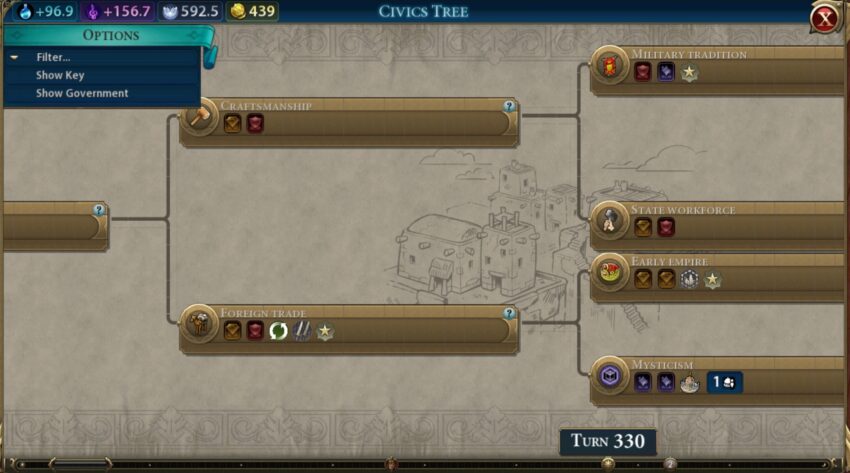

Military Policies
Discipline
+5 Unit Combat Strength when fighting Barbarians.
Made obsolete by:
- Native Conquest
Required Civics:
- Code of Laws
In Caesar’s Gallic Wars, he describes how the Gauls fought – each man charged at the enemy, desperate to prove his own might and worth. And the Gauls were intimidating fighters: massive, brawny men, some entirely naked. But the Romans, if they were prepared (and not ambushed) slaughtered them, because each soldier saw himself not as a potential hero, but as part of a unit.
With the rise of professional armies, military law became codified and more convoluted, although punishment hasn’t changed much- between 1942 and 1961 AD 160 members of the American military were executed under the auspices of the Uniform Code of Military Justice for various crimes, including desertion, mutiny, and murder.
Survey
Double experience for recon units.
Made obsolete by:
- Native Conquest
Required Civics:
- Code of Laws
Even prehistoric tribes had “scouts,” those hardy individuals who went out looking for better caves, hunting grounds, and sources of water. Once folk settled down and began clumping together in villages and towns, fleet-footed and eagle-eyed individuals willing to hike over the hills and trudge through trackless forests remained of vital importance, for a civilization that doesn’t know what’s going on around it is blind to both opportunities and dangers.
As they surveyed the surroundings and brought back tales of fabulous wonders, scouts not only expanded possibilities, but humanity’s imagination as well.
Agoge
+50% Production toward Ancient and Classical era melee, anti-cavalry, and ranged units.
Made obsolete by:
- Feudal Contract
Required Civics:
- Craftsmanship
In Attic Greek, “agoge” meant “rearing” – the rigorous education and training mandated for all Spartan males. Besides cultivating loyalty to Sparta, the state schools included instruction in military arts, pain tolerance, hunting, dancing, singing, public speaking, and all manner of things that make for a warrior.
There was also a form for Spartan girls, although the curriculum was somewhat different (intended to prepare them to give birth to warriors). The practice of agoge waned in the 3rd Century BC throughout Greece, but was revived in some places after the Roman victory in the Achaean War.
Maritime Industries
+100% Production toward Ancient and Classical era naval units.
Made obsolete by:
- Press Gangs
- International Waters
Required Civics:
- Foreign Trade
In some ancient places, men took to the seas, exploring, fishing, trading, and fighting. And in some of those places, maritime industries – the construction and outfitting of ships – haphazardly arose, making these men somewhat better at this exploring, fishing, trading, and fighting.
Although the Egyptians built the first sea-going ships, the Minoans were the first great seafarers of history, trading as far away as Sicily while their King Minos conquered the other Aegean islands. The Phoenicians built a maritime “empire” of loosely-allied city-states. In far India, the Mauryan Empire (4th Century BC) developed the earliest known state organization for shipbuilding, and “invented” the science of navigation.
Maneuver
+50% Production toward Ancient and Classical era heavy and light cavalry units.
Made obsolete by:
- Chivalry
- Lightning Warfare
Required Civics:
- Military Tradition
Once warfare moved past the stage of small masses of men just having at it in a club-thumping melee, maneuvers gave the more nimble warriors a distinct advantage in battle. The concept of using rapid movements to keep the enemy at a disadvantage is almost as old as the idea of war itself.
Tactical maneuvers are intended to be used on the battlefield, while “maneuver warfare” covers all that leads up to forcing an enemy to fight at a place or time they’d rather not. Both types came to prominence with the advent of chariots and cavalry… and their importance hasn’t diminished since.
Conscription
Unit maintenance reduced by 1 Gold per turn, per unit.
Made obsolete by:
- Levée en Masse
Required Civics:
- State Workforce
Military conscription is found in most ancient civilizations without professional armies (distinguished from the ilkum and corvee systems, which tended to be devoted to more pacific activities).
Rather, levies of more-or-less able-bodied and more-or-less trained “recruits” were necessary in times of unrest. Although armament and ability varied considerably, such levies generally fought as infantry under their king or his designates.
However, early wars didn’t last long; it was in everyone’s interest to get the battles over with in time for harvest, as most of the conscripts were farmers. But, at least, they were cheap.

Economic Policies
God King
+1 Faith and +1 Gold in the Capital.
Made obsolete by:
- Scripture
Required Civics:
- Code of Laws
Not satisfied with being mere kings, some ruling dynasties took on the mantle of divinity to insure obedience, prestige, and infallibility. Egyptian pharaohs were generally believed to be incarnations of the god Horus.
In imperial China at times the emperor was considered the “Son of Heaven,” ruling under the “Mandate of Heaven” with his commands believed sacred writ. Some Roman emperors were declared gods by the Senate, but generally after their death, so godhood didn’t interfere with their duties.
Although all this godliness was eventually replaced with the divine right of kings to rule, it has echoed throughout the course of civilization.
Urban Planning
+1 Production in all cities
Made obsolete by:
- Colonial Offices
According to archeologists, there is evidence of urban planning – or at least something more than haphazard building – in a number of ancient towns found in Mesopotamia, Egypt, and the Indus Valley. They have uncovered paved streets laid out in a grid pattern, and from the 8th Century BC onward most
Greek cities were laid out on orthogonal grid plans. But it was the Romans who were masters of urban planning – far more so than other civilizations. Roman city planning focused on military defense, public convenience, and ease of transport through the streets (connecting to those nice roads).
As Rome declined, most of these nifty ideas disappeared for a time, although the great European cities still surround a Roman city center.
Ilkum
+30% Production toward Builders.
Made obsolete by:
- Serfdom
Required Civics:
- Craftsmanship
Conscription was first instituted during the reign of Hammurabi (around 1750 BC). Under this ilkum system, the Babylonian Empire could call upon anyone to serve in the army during time of war; during the plentiful times of peace, his subjects were instead required to provide unpaid labor for other activities deemed important – building projects, harvesting crops, producing trade goods, and anything else the “good of the state” might require. (In return, the conscripts gained the right to hold land.)
Over the following centuries, various other empires instituted similar systems, eventually evolving into the feudal system so popular with the peasants of medieval Europe.
Caravansaries
+2 Gold from all Trade Routes.
Made obsolete by:
- Triangular Trade
Required Civics:
- Foreign Trade
As caravan routes expanded across the Middle East, Central Asia, and North Africa, the need for places where pack animals and human handlers could pause for rest, shelter, provisions, and safety – for a fee, of course – grew.
Public caravansaries were complexes built outside the walls of towns and cities; private ones usually took the form of walled enclosures in the middle of nowhere with storerooms and sleeping quarters, stables, and kitchens.
The largest could accommodate hundreds of camels, mules, or horses. The oldest recorded caravansaries were found along the Persian Empire’s Royal Road, stretching some 1600 km (1000 miles) from Sardis to Susa.
Corvee
+15% Production toward Ancient and Classical wonders.
Made obsolete by:
- Gothic Architecture
- Skyscrapers
Required Civics:
- State Workforce
Although the term refers to the medieval practice of paying one’s taxes through unpaid labor – typically a certain number of days each year – “corvée” has been around since ancient Egypt. From roughly 2600 BC onward, the Old Kingdom used such “taxes” to build pyramids, temples and monuments.
Imperial China had a similar system in place; Qin Shi Huang and subsequent emperors imposed it for public works such as the Great Wall and the Grand Canal. By the Middle Ages, corvée was embedded in the feudal system, with tenants required to perform construction work on the private lands of their lords.
Thus, throughout history the gentry had nice homes and tombs while everyone else had hovels.
Land Surveyors
Reduces the cost of purchasing a tile by 20%.
Made obsolete by:
- Expropriation
Required Civics:
- Early Empire
Once the idea of ownership of the land was ingrained in humanity, methods for determining boundaries were necessary. In ancient Egypt, a rope with knots could be used with simple geometry to re-establish boundaries after the annual floods along the Nile.
Land surveyors were also at work around those old monuments tourists are now enamored of; Stonehenge was laid out by surveyors using pegs and ropes, as was the Great Pyramid of Giza.
The Chinese Liu Hui described methods of surveying in works published c. 263 AD. But it was the Romans who first acknowledged land surveying as a profession; there, surveyors were known as Gromatici, so named after the Groma instrument dating back to ancient Mesopotamia.
Colonisation
+50% Production toward Settlers.
Made obsolete by:
- Expropriation
Required Civics:
- Early Empire
The urge to procreate is a basic human trait, as true of civilizations as of individuals. In early times, these were usually established by maritime city-states on distant (relatively) shores; the Greeks and Phoenicians scattered them around the Mediterranean coasts in what they considered uninhabited lands.
The Romans created colonial cities on the fringes of their empire across Western Europe, North Africa, and West Asia. Early Chinese dynasties pursued a similar policy. Through the troubled Middle Ages, the only people to undertake large-scale settling were the foot-loose Vikings, but once other Europeans began crossing the oceans they all started planting colonies all over the globe… and squabbling over who got what.

Great Person Policies
Inspiration
+2 point Great Scientist points per turn.
Made obsolete by;
- Nobel Prize
Required Civics:
- Mysticism
Some new ideas come from trial and error; others, from inspiration (artistic, imaginative, or perhaps divine). Whatever the source, inspiration has brought about many notable advances in scientific knowledge and technology.
Commonly known as the ‘Eureka’ moment (as any mad scientist knows), the term comes from a story about the Greek polymath Archimedes’ sudden epiphany c. 250 BC concerning how to prove whether a crown was pure gold or not. Inspiration cannot be called upon as desired; in fact, a recent study by Mareike Wieth and Rose Zacks suggests that insight and innovation are greatest when an individual is not at his/her best. So there’s hope for us yet.
Revelation
+2 points to Great Prophet points per turn.
Made obsolete by:
- Invention
Required Civics:
- Mysticism
Religiously speaking, revelation is the revealing of some form of truth or knowledge through direct communication with a deity or other supernatural entity through various means – burning bushes, graven tablets, voices from statues, drug-induced dreams, and the list continues.
Virtually every prophet from Moses to Mohammed to Joseph Smith has claimed the revelation to them personally of holy writ. Whether confabulation or fact, there is no denying that divine revelations have shaped civilization throughout the millennia. Recent scientific studies by Stanley Koren have sought to understand the phenomenon through the use of the “God helmet,” a device for stimulating the temporal lobes… perhaps soon everyone can have revelations.