Ancient Era
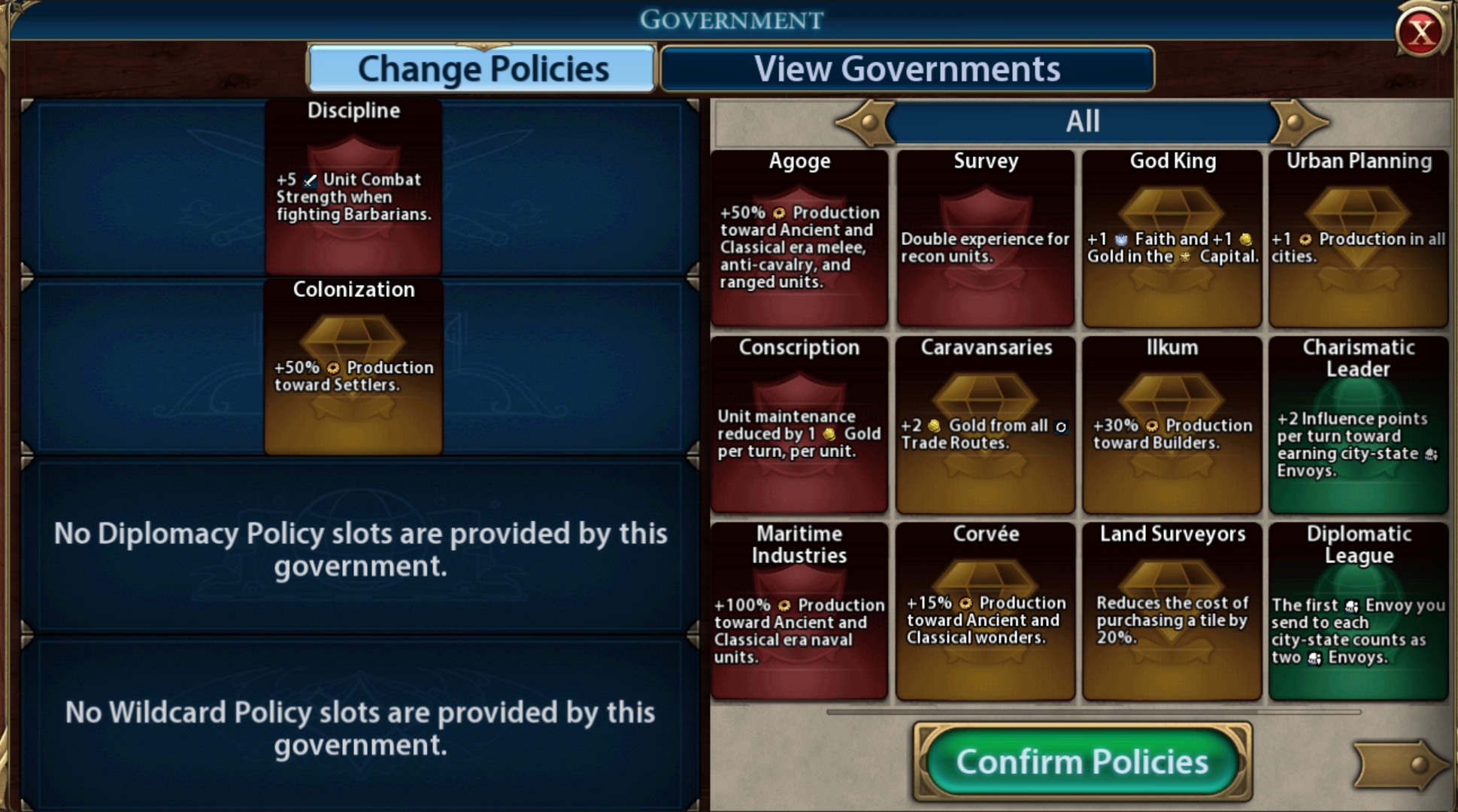
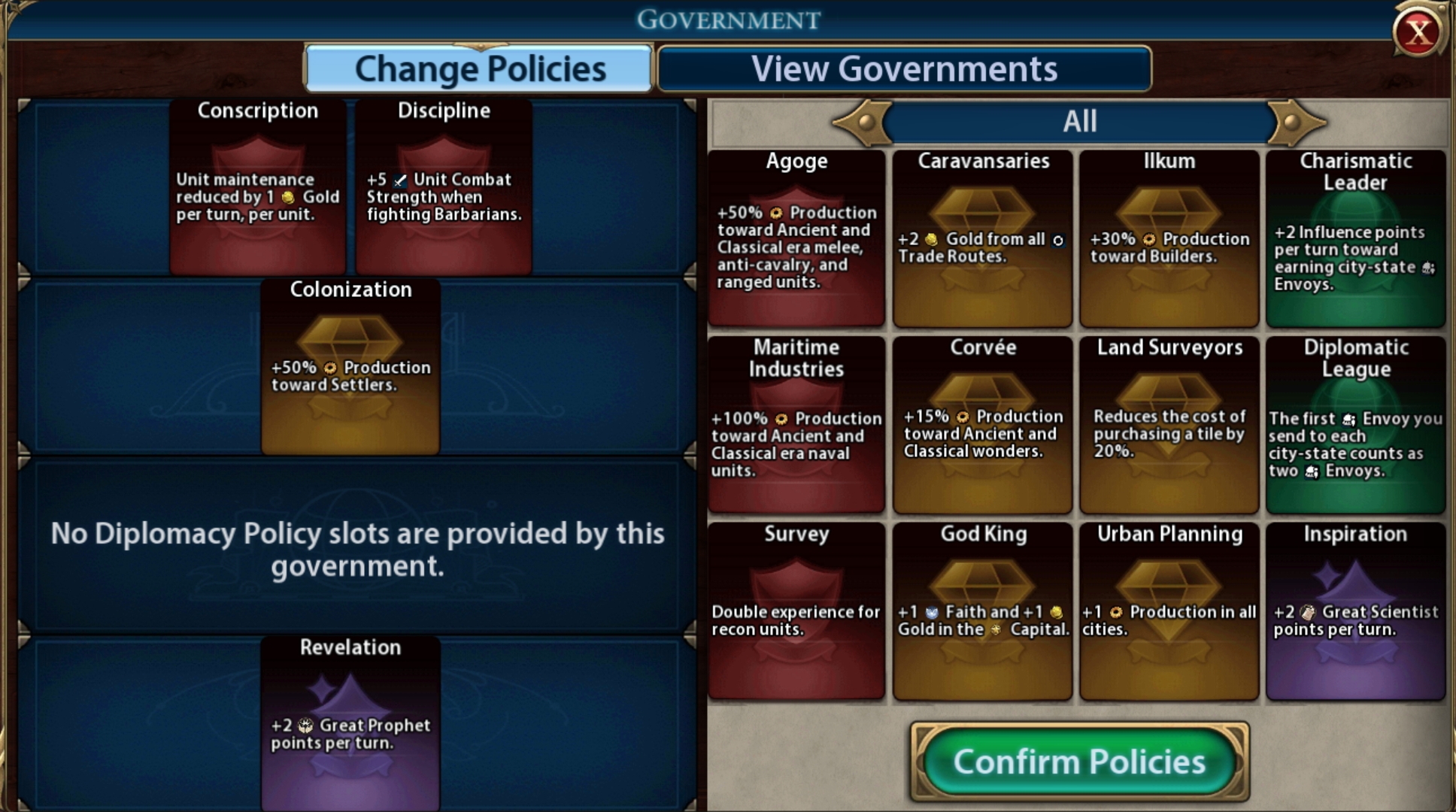
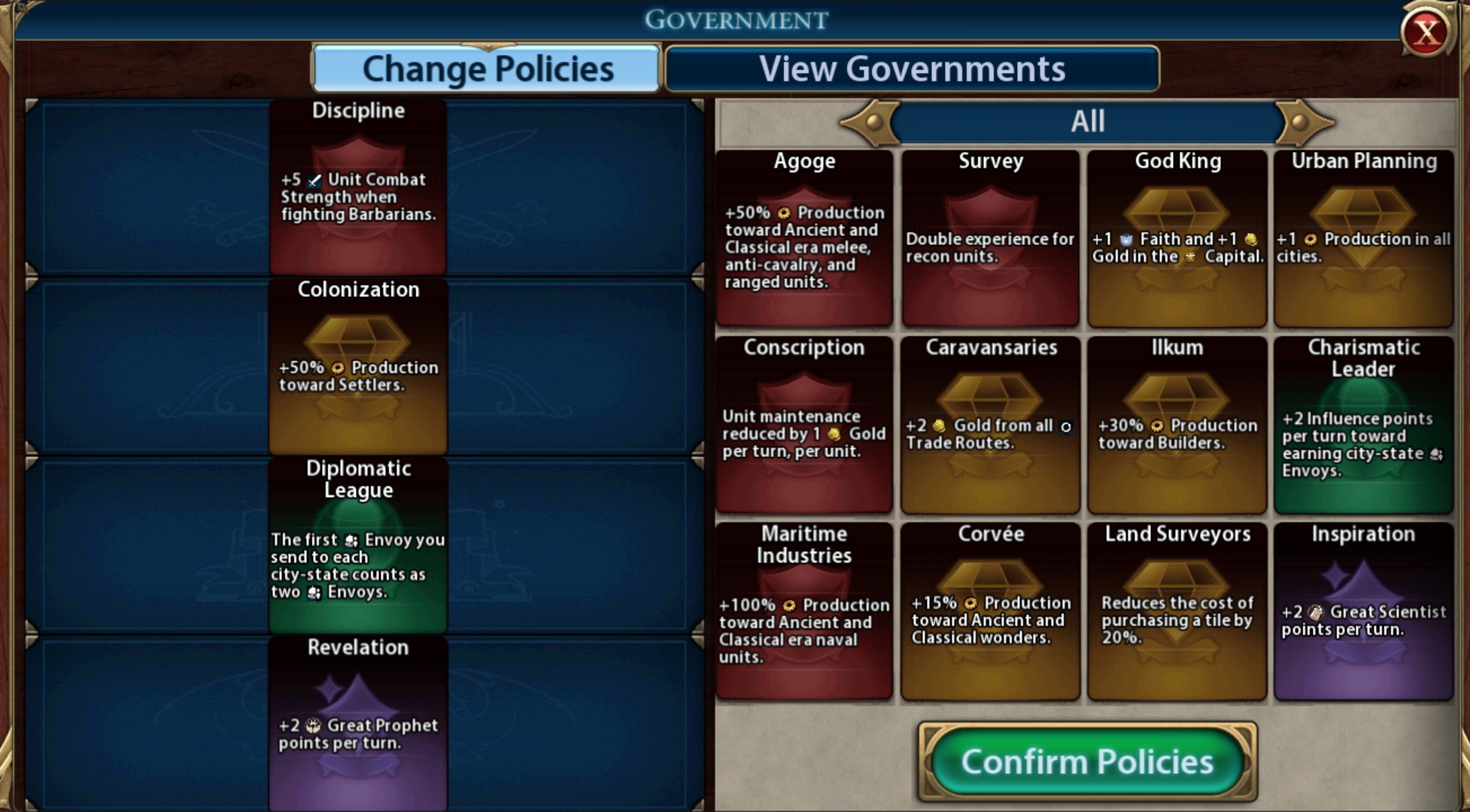
CHIEFDOM (1 1 0 0)
To unlock:
- Code of Laws (20 culture)
In the last century, anthropologist Robert Carneiro defined chiefdoms as “an autonomous political unit comprising a number of villages… under the permanent control of a paramount chief.” Departing from more egalitarian groupings, chiefdoms could range from rule by a council of elders to an individual of a noble lineage to a shifting sort of political organization depending on what the society was doing at the moment (e.g. waging war or remaining peaceful).
Because of the sheer variety of small-scale political forms, the term has outlived some of its usefulness, but still might be used to describe groups such as the 19th-century Nuer (in East Africa), who had certain elite lineages of princely chiefs, or the 17th-century Powhatan confederacy (in Virginia).
The advantage of chiefdoms was the ability to deal with populations in the abstract. One did not need to personally know each individual if one had a system of hierarchy – you might describe yourself as a noble, warrior or commoner, rather than simply as yourself. This, then, allows for larger-scale organizations to form, like cities or “civilizations.”
Of course, as James C. Scott notes, early societies were largely unfree, as large-scale agriculture demanded particular kinds of labor – namely, serfdom or, in its worst form, slavery. As populations expanded and this need for increased abstraction did as well, chiefdoms grew along particular lines: princely lineages became monarchies, charismatic personalities became autocrats, and councils of elders became oligarchies.
Classical Era
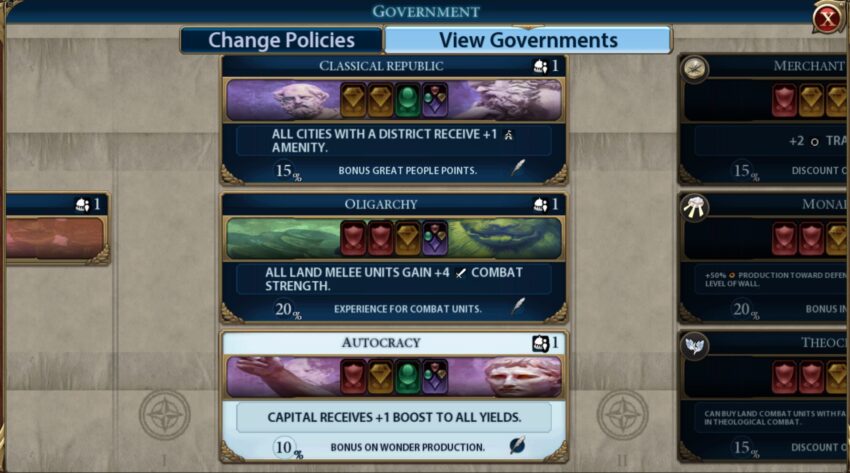
Classical Republic (0 2 1 1)
- All cities with a district receives +1 Amenity.
- Bonus great people points 15%.
To unlock:
- Political Philosophy (110 Culture)

Cleisthenes’ Athens, pre-Caesar Rome, Carthage, as well as a host of less-famous civilizations have followed a republican model. In a republic, power rests with selected individuals who represent the citizenry (usually some limited sector of the citizenry) and rule in accordance with some mutually agreed-upon law.
A generalized “republic” might refer to governments such as Iceland’s “Althing” – a medieval parliament, or to the Tlaxcala Nahua state – a pre-Colombian free state in Mexico that had a representative assembly, including (shockingly, for Classical Greek minds) commoners’ representation.
But the word “republic” draws most clearly to mind the Mediterranean, and especially the Roman Republic (509 BC-27 BC), with its complex system of assemblies and magistrates, all drawing upon the idea of a “civic” sector – a representative sample of particular populations, as well as some degree of checks against the rise of autocracy. Of course, the latter didn’t work out for Rome.
These notions of civic pride and civil society re-emerged during the Renaissance to influence modern European political theory. Here, as Europe incorporated ideas from antiquity and engaged with the Muslim world, new alternatives to the divine right of kings emerged.
City-states especially in Italy embraced republican ideas – and writers such as the political theorist Niccolo Machiavelli provided an updated blueprint. But in so doing, the notions of civic virtue and the institutions of the Classical Republic had changed, moving forward towards something new.
Oligarchy (2 1 0 1)
- All land melle units gain +4 combat strength
- 20% experience for combat units.
To unlock:
- Political Philosophy (110 Culture)
The Greeks coined the term “oligarchy” to mean “rule by the few.” Whether distinguished from the hoi polloi by family ties, religious or military prestige, personal achievements, or other attributes – Aristotle used the term to refer to rule by the rich, and Plato in The Republic argued for rule by an educated elite – the oligarchs determine what issues should be on the political agenda, debate these, and then decide “for the good of the people.”
Depending on the qualifications imposed to be an oligarch, oligarchy can be efficient, or it can generate a viper’s nest of intrigue.
The classic examples of oligarchy are found in ancient Greece – Corinth, Sparta, Thebes, in fact all the major city-states… except the democratic Athenians. However, recent works by political scholars such as the German sociologist Robert Michels argue there is an “Iron Law of Oligarchy” whereby all forms of government tend inevitably towards oligarchy.
Even in representative democracies, the practical demands of governance results in the concentration of political power in a small group, in a monolithic bureaucracy, and in rigorous means to control dissention. Which may be a good thing, as the historian Spencer Weart claims that oligarchies rarely make war on each other.
Autocracy (1 1 1 1)
- Capital receives +1 boost to all yield
- Bonus on wonder production 10%.
To unlock:
- Political Philosophy (110 Culture)
The Greek historian Herodotus describes a debate between three would-be Persian rulers. One advocates for democracy, another for an oligarchy, but Darius counters each. In a democracy, ill-informed masses may fall under the sway of a charismatic, short-sighted leader (as they continue to do to this day), and in an oligarchy, one oligarch inevitably triumphs over the others.
Rule by one person, Darius argues, is ideal, so long as that one person is the best person. “Seeing that using the best judgement he would be the guardian of the multitude without reproach,” Darius argues. Further, Darius proposes – perhaps unsurprisingly – that he should be the person for the job: “whence arose the liberty which we possess, and who gave it to us? … Having been set free by one man, [we] should preserve that form of rule.” Convenient for Darius (to be fair, Herodotus is producing a piece of Greek anti-Persian propaganda here, so his account must be taken with a grain of salt).
Rule by the judgement of one means that the palace is able to muster resources – serfs or soldiers – for whatever seems important at the time to the autocrat. Some of the great wonders of civilization – the Sphinx, Great Wall, Taj Mahal, Hermitage, etc – have been the fancy of autocrats. Some of the best armies of civilization have been those of autocrats (useful for keeping an eye on their people as well as invading neighbors)…
Medieval Era
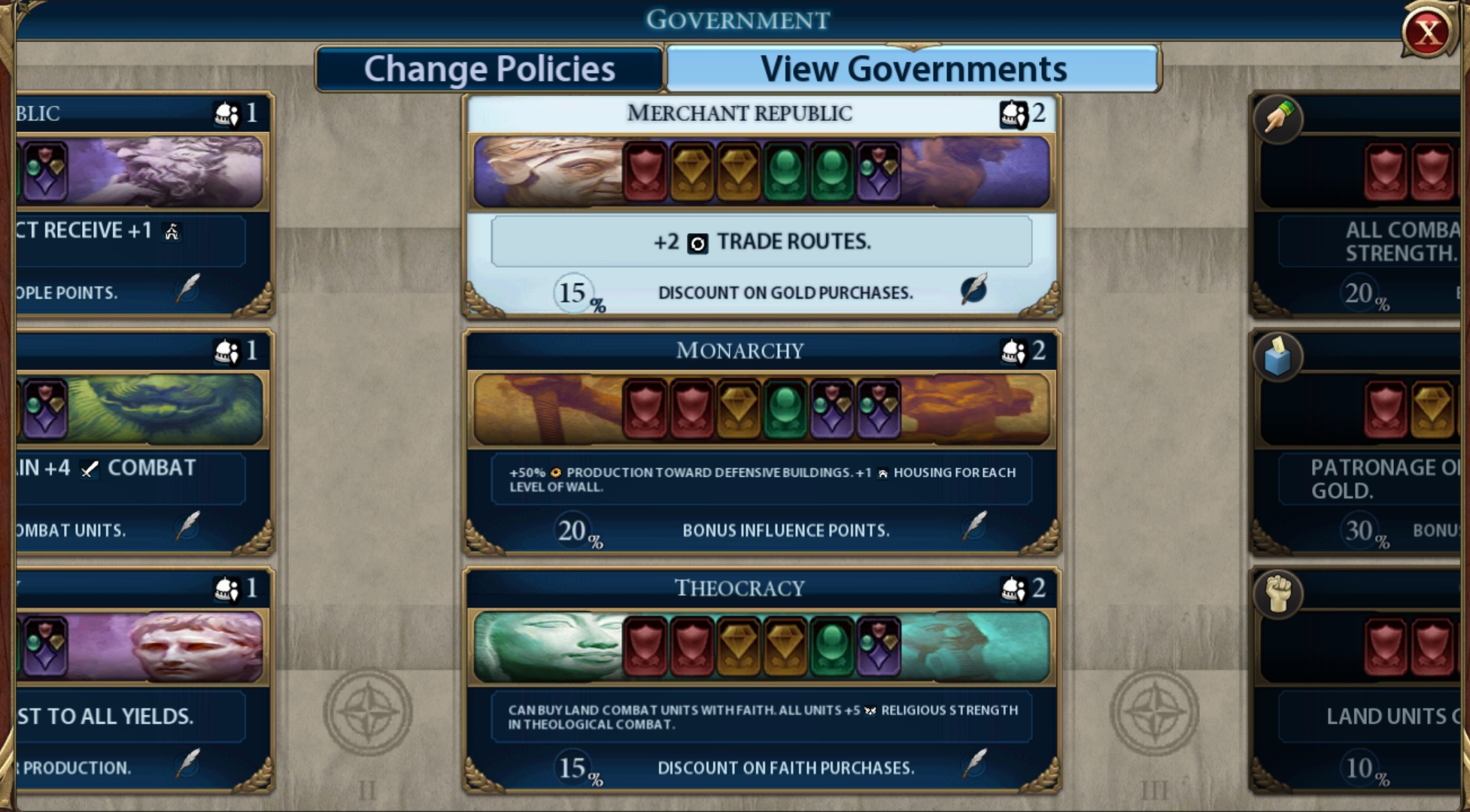
Monarchy (2 1 1 2)
- 50% production towards defensive buildings
- +1 housing for each level of wall.
- 20% bonus influence points.
To unlock:
- Divine Right (290 Culture)
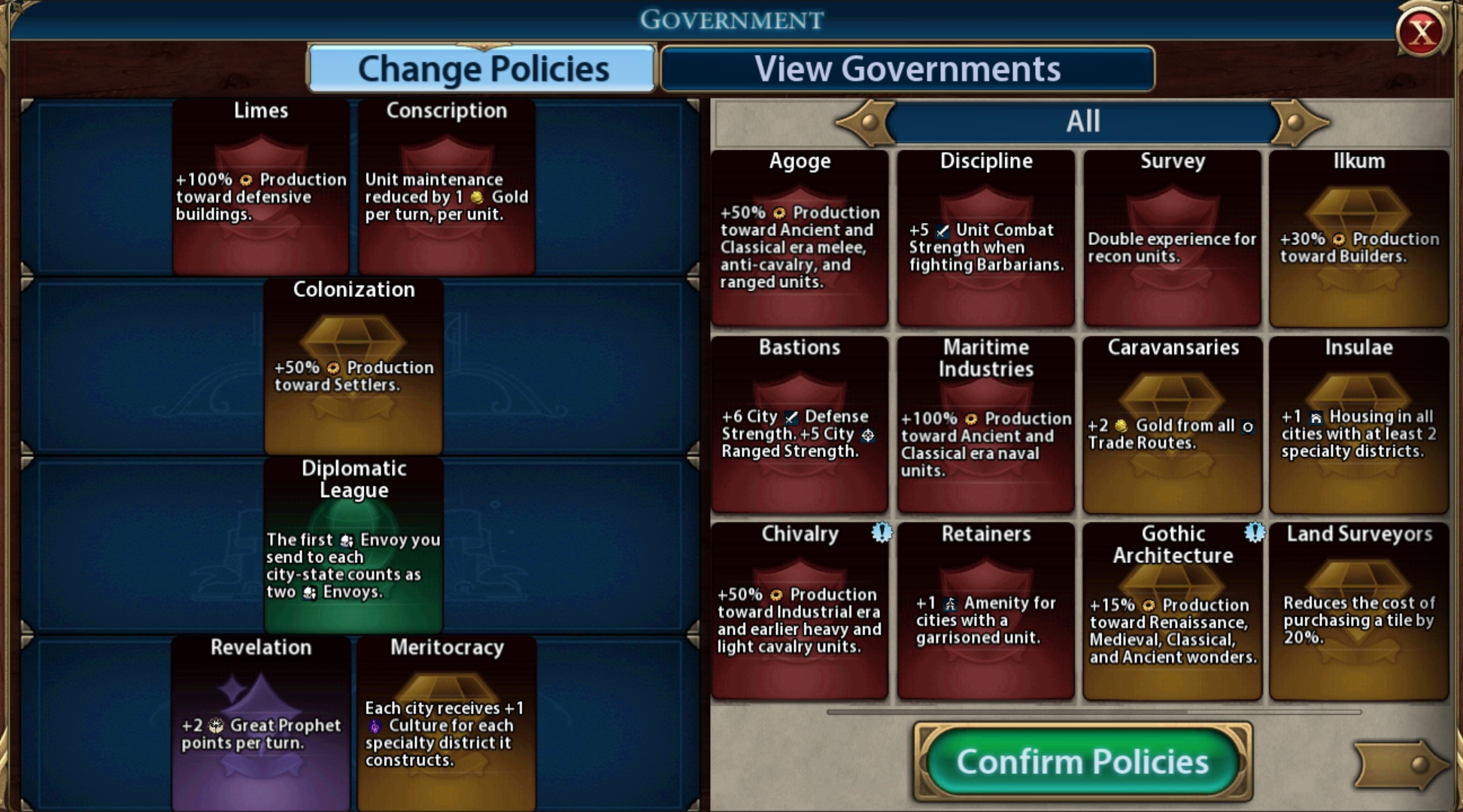
Monarchy rests on the idea of sovereignty vested in a single individual, from a single (often divinely-attributed) bloodline – a king, queen, prince, etc – ruling until abdication or death (or, in the case of a revolution, often both). The successor to all this power is usually determined by heredity, next in line in the (more-or-less) direct royal lineage.
Monarchies come in many flavors – Khmer kings reckoned their origins to the union of a Brahmin king and a naga [water dragon] queen, and Majapahit monarchs claimed descent from the Hindu gods. But there are varieties of monarch.
An absolute monarchy is one in which there are no restraints on the wielding of power (think the German Kaiser), whereas in a constitutional monarchy (think the British queen), the ruler’s power is somewhat constrained by law… no “off with his head” without a trial, for instance. In an electoral monarchy, the ruler is elected, usually by some form of special convocation (such as that for the Holy Roman Empire).
Absolute monarchies work as well as the monarch and the bureaucracy built around him or her, provided the ruler is as gifted as Elizabeth I, Frederick the Great or Qin Shi Huang. Otherwise, the nation tends to slip in stagnation. And for the truly inept, revolution looms: Charles I, Louis XVI, Tsar Nicholas II, and a long list of others.
Rather more stable and successful are constitutional monarchies, many of which began as elective monarchies. Most of the world’s current monarchies are constitutional, with the ruler serving in a symbolic, traditional, patriotic and propaganda role. Which is not to say that their role is not influential or important… just look to the Queen of England or Emperor of Japan. Certain other monarchs (Thailand, Swaziland, Bhutan) excersie a bit more control.
Merchant Republic (1 2 2 1)
- +2 Trade routes
- 15% discount on gold purchases
To unlock:
- Exploration (400 Culture)
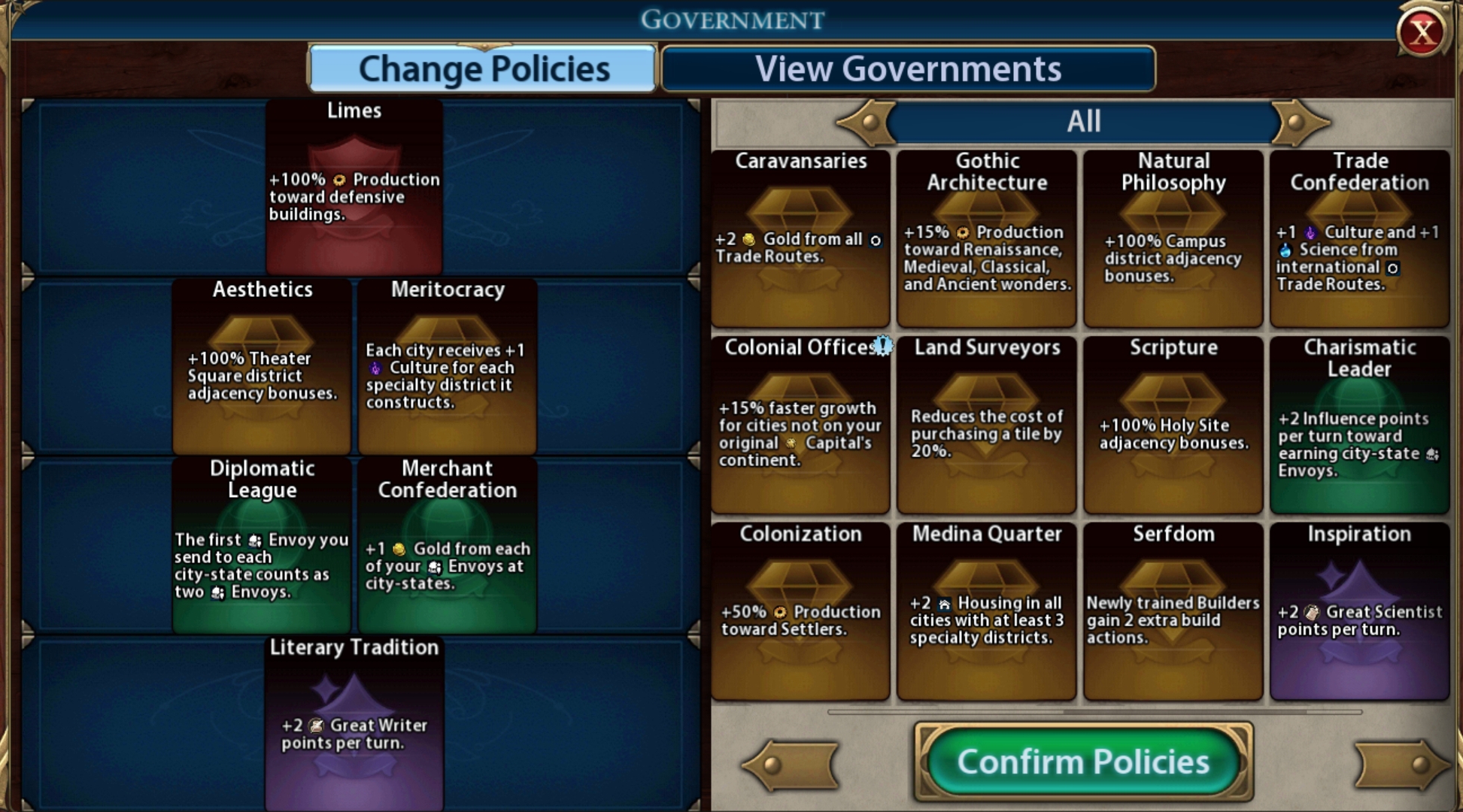
In the early Renaissance, a number of small, wealthy, trade-based nations embraced republican ideals, notably across Italy and the Baltic. In these “mercantile republics,” the leaders – usually a council of merchants headed by a doge or mayor – were elected by the citizenry with the primary duty of increasing the city-state’s collective wealth.
Thus, while military affairs were of importance, these were usually focused on opening or guarding trade routes. And diplomacy was centered on such matters as tariffs, customs duties and financial matters. In short, merchant republics had capital lead the way, and gave a pragmatic approach to governing, although occasionally they were not immune to misguided visions of glory, as when the aged Doge Dandolo joined the Fourth Crusade and helped sack Constantinople.
In general, these mercantile republics arose in regions of Europe where feudal control by an absolutist monarchy was minimal or absent completely. In the Holy Roman Empire, 51 “free imperial cities,” many later composing the Hanseatic League, established chartered mercantile republics.
To the east, two Russian cities – Novgorod and Pskov – pursued republicanism into the 15th Century until Muscovy put an end to any pretensions of independence. But it was in Italy that mercantile republican aspirations reached their culmination, with powerful city-states such as Venice, Genoa, Pisa, Florence and others dominating the landscape until the Napoleonic Wars subsumed their greed.
Theocracy (2 2 1 1)
- Can buy land combat unit with faith.
- all units +5 religious strength in theological combat.
To unlock:
- Reformed Church (400 Culture)
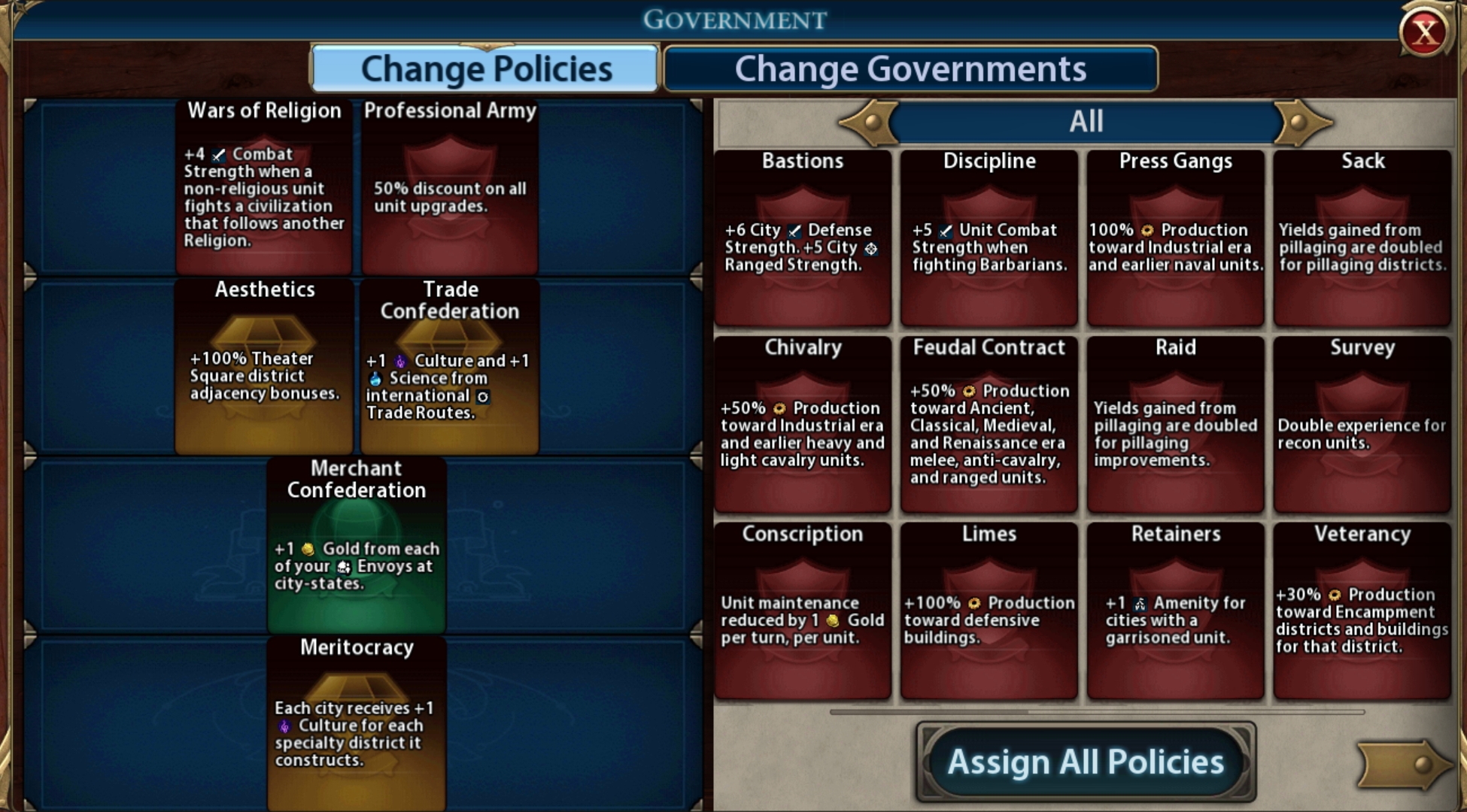
“As God Wills” is the mantra for a theocracy, whatever the religion. A theocracy is, simply, a form of government in which some deity is the immediate authority, usually personified by human representative(s) who interprets the “Word” for the common folk. In a pure theocracy, the civil leader has a direct connection to God – Moses for the Israelites, Muhammad for the Arabs, Joseph Smith for Deseret, the Pope for Vatican City, the Ayatollah for the Islamic Republic of Iran, etc.
However, most of civilization’s examples of “rule by God” are in fact quasi-theocracies, in which the ruler is a demi-god or can claim a divine commission to rule. In such, the notion of separation of church and state is a heresy. And everyone knows what happens to heretics.
In ancient Egypt, the pharaoh was believed a demi-god, as was the emperor of the Aztecs. In other cases, the ruler’s connection to the divine was somewhat more tenuous … but effective in insuring secular obedience nonetheless.
Due to their nature, theocracies tend to have a high level of patriotism (hence, answering the call for war is a matter of faith as well as civic duty), to be well organized as a temple, and enjoy higher productivity (again, as a matter of faith). The downside is that they tend to be rigid and slow to react, and hence prone to collapse in the face of crises.
Modern Era
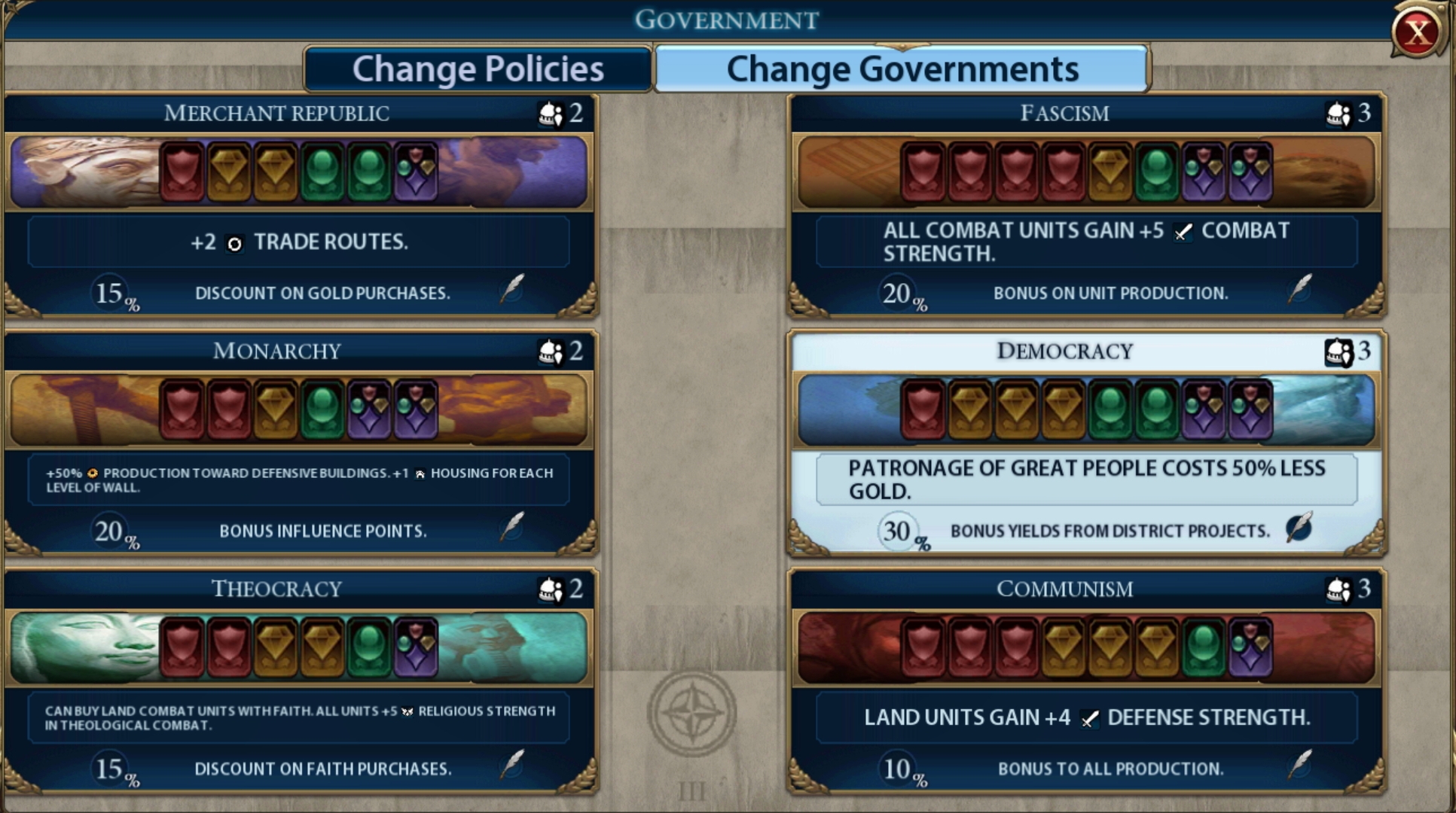
Fascism (4 1 1 2)
- All combat units gain +5 strength.
- Bonus 20% on unit production.
To unlock:
- Totalitarianism (1715 Culture)
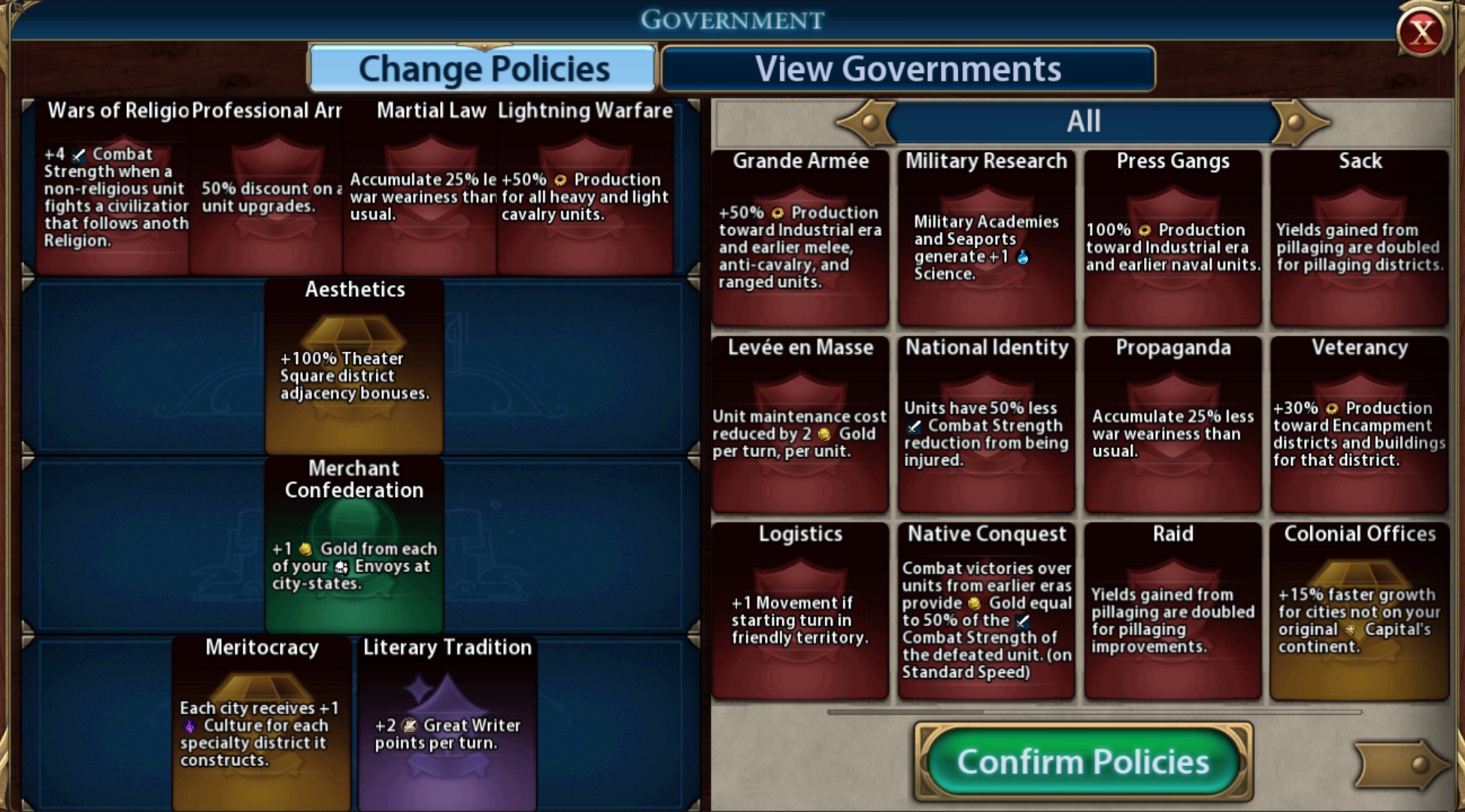
Fascism – authoritarian nationalism – evolved in the chaos caused by the First World War and the world-wide Great Depression. While it technically refers to the Fascist Party, a political group in Italy, we use the term to refer to governments such as Imperial Japan, Mussolini’s Italy, Franco’s Spain, and Nazi Germany.
While in its focus upon the figure of the leader, fascism resembles an extreme form of modernity, it is ultimately a futurist ideology, seeking to reshape society anew. In the early 20th century, the nature of war, society and technology underwent such extreme changes that fascist movements sprang up in many countries (including democracies such as Great Britain, the United States, France, Italy, Germany and others) around the globe.
In some, fascist political parties managed to seize power through guile, bloodshed or even elections: Italy, Germany, Spain, Portugal, Hungary, and Nationalist China, where Chiang Kai-shek considered fascism to be the “practical” solution to rapid modernization. Other nations, notably several across South America and Asia, embraced varieties of fascist ideology.
Marked by militarism, nationalism, modernism, repression, and opposition to Communism, fascist governments embody totalitarianism, in which the state seeks to control the hearts and minds of its citizens via propaganda or outright repression. In terms of economics, fascist systems incorporate elements of both capitalist and socialist systems, in that they mobilize private industry for state (read: military) might.
With the defeat of the Axis in World War II, fascism ceased to be a present danger to the world order, but fascist regimes and tendencies continued elsewhere (and continue in places today that emphasize a strong leader and military might), and fascist political movements can be found nearly every place, waving the flag of racist ethno-nationalism, monarchy, or rabid national pride.
Communism (3 3 1 1)
- Land units gain +4 defence strength.
- Bonus to all production 10%.
To unlock:
- Class Struggle (1715 Culture)
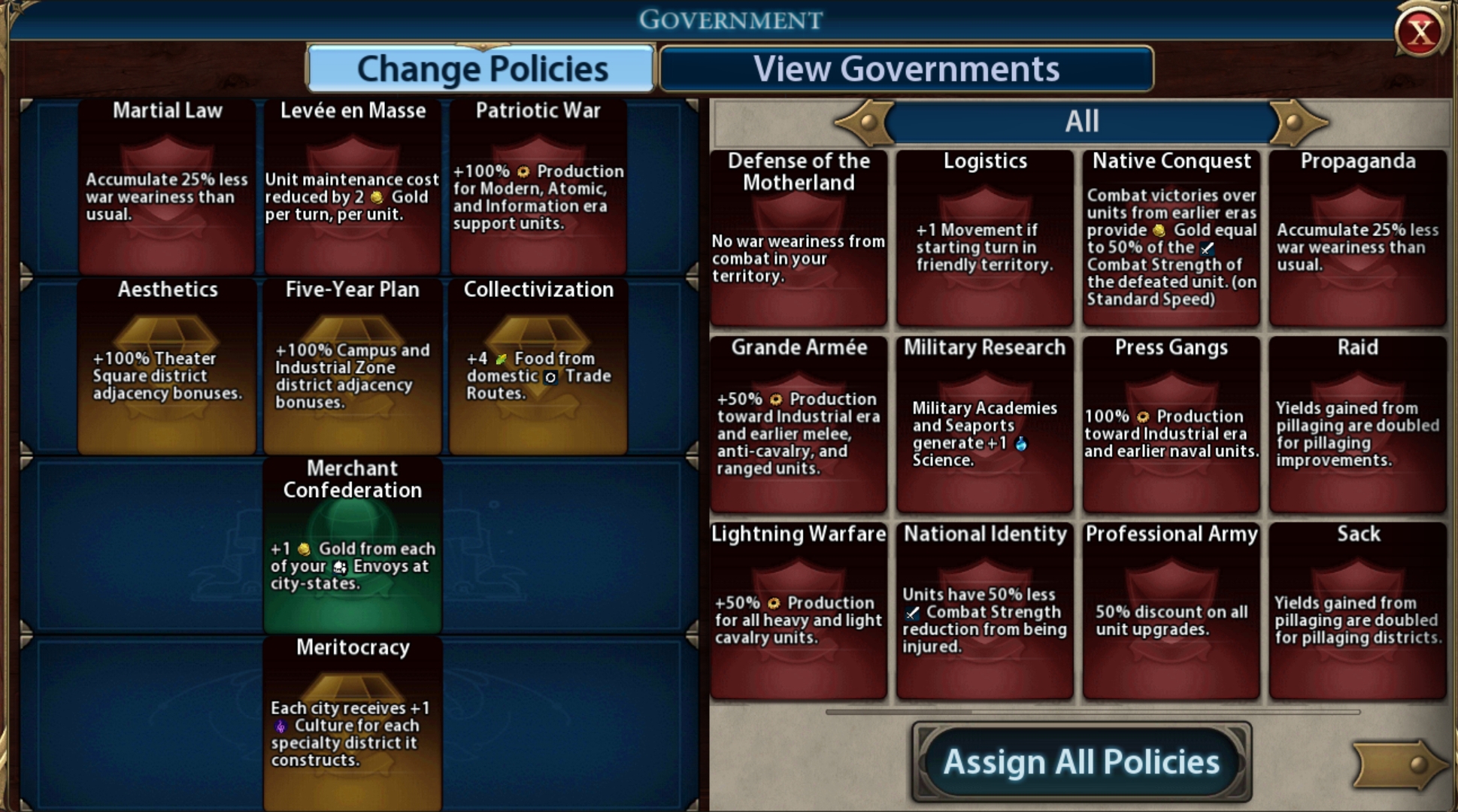
In theory more of an economic system, rather than a system of government, communist theory rests on the tension between work and value in society. In Karl Marx’s writings, Marx presents a problem: work creates value, but workers (“the proletariat”) are paid the minimum wages required to keep them fed and keep them around.
All profit goes to those who own the factory (or farm, or company stock, or, for Marx, the “means of production”). For many in the late-19th and early 20th-century, this sounded like theft- the fruits of their labor were being stolen by factory owners (“the bourgeoisie”) who did no work themselves. And thus, the idea of communism was born – the “dictatorship of the proletariat”, meaning the rule by those who worked, and the free access by workers to the fruits of their own labor.
This was not anything like an autocratic “dictatorship:” ideally, “the proletariat” would eventually mean everyone, where workers “gave according to ability and received according to need” and participated democratically in government (though functioning democratic rule in major communist states is hard to find in history). In practice, Communist states struggled with how to implement such a vision.
While Marx’s model used industrial production as its base – what should agricultural societies do? Communism saw religion as a hoax used to keep the lower classes in their place, but should be done with those workers who felt a deep attachment to their beliefs? Communism saw the struggle as one that transcended national boundaries and ethnicities, but what about people who couldn’t accept international unity? In answer to these questions, Marx’s ideology became fractured and fragmented.
The Soviet Union embraced an idea that a select group – the Communist Party – should lead the charge in implementing these changes (creating the “Marxist-Leninist” tradition, as we see now in places like Vietnam), and, later, Joseph Stalin re-introduced nationalism and an idea of a charismatic leader to a previously anti-nationalist ideology.
And as the Soviets progressed, they found themselves having more and more to suppress dissenting voices with harsher and harsher tactics. Elsewhere, Mao suggested that agricultural peasants – not industrial workers – should be at the heart of a movement. Building upon Stalin’s legacy, other leaders in places such as North Korea built totalitarian societies that could be indistinguishable from the fascist ideologies that they purported to oppose.
Communism became an attractive option for many nations emerging from European colonialism. Whereas capitalist nations promised the “Third World” that membership in an international community dominated by Western companies, communists offered self-reliance and resistance to that order, albiet at the cost of bringing national politics in line with the USSR.
But nationalism was important, too, in such emerging bodies politic – it was national sentiment that led to the overthrow of colonial regimes. So the Cold War was born: capitalist versus communist international orders that tore apart any nation that sought to go a middle way, and often fostered authoritarian regimes that bore little resemblance to their democratic ideals – the worst horror carried out under the name of communism might be the Khmer Rouge, a Maoist Cambodian regime that sought to reset society to a utopian level, and ended up carrying out a genocide until (also communist) Vietnamese forces intervened and ended the slaughter.
Communist parties still exist, often as minor political parties, in many countries, and many nominally Communist states have embraced some form of capitalism (China and Vietnam, most notably). At least on paper, currently-existing communist states include Cuba, China, Vietnam, and Laos, with North Korea’s “Juche” blend of communism and totalitarianism often also included.
Democracy (1 3 2 2)
- Patronage of great people cost 50% less gold.
- Bonus yields from district projects 30%.
To unlock:
- Suffrage (1715 Culture)
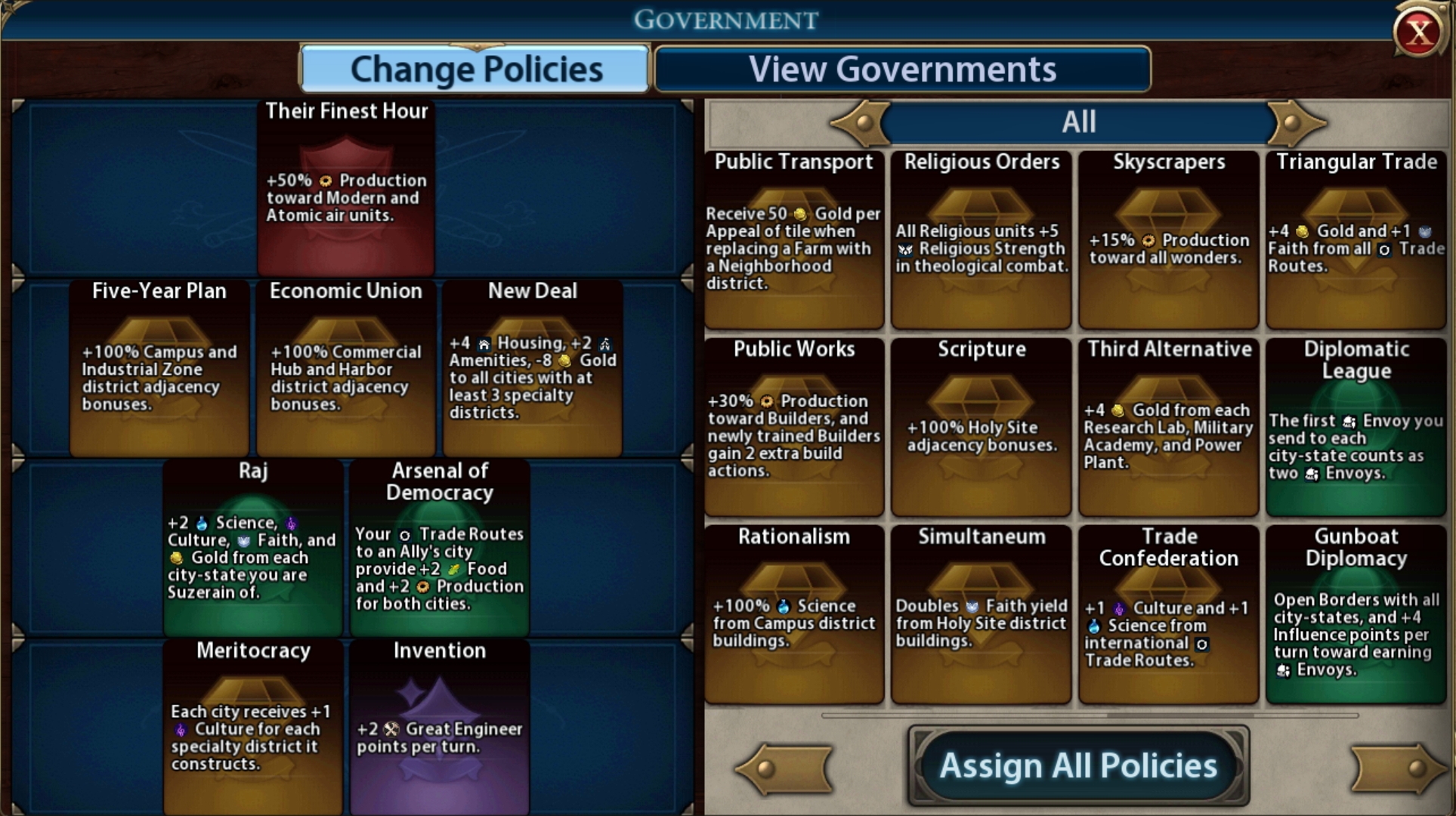
Literally “rule by the ordinary people,” a democratic government is one in which a large number – ideally all – of the population are involved in making policy decisions, either directly or through elected representatives.
What constitutes “the people” is always a fraught issue – while states such as the USA extend voting rights to most, this has not always been the case, as African-Americans, indigenous groups, and women for long were barred from participation in civic life.
Democracy is a “liberal” system, if by liberal here we mean the notion of a free individual exercising individual opinions and thus leading to a collective good (and not in its common use as “not conservative”). Ideally, such a system ensures civil liberties, active participation, human rights, and a rule of law. However, as Herodotus reminds us (and dictators ever since have reinforced), the majority may not have its own interest at heart.
While freedom of speech, freedom of political expression, freedom of belief, and freedom of the press all sound wonderful, these can bring discord, instability, apathy, paralysis, and violence in the face of challenges. On the other hand, such individual freedoms can lead to bursts of artistic and scientific creativity, economic abundance, and free expression.
Early democracies were generally “direct” democracies, in the sense that the franchised (i.e. those who could vote – generally excluding women, slaves, those without property, etc) voted on each important matter in assembly. But as the population grew, this proved impractical.
Thus, most democracies evolved as did the Roman Republic, with the citizens (however determined) electing representatives to voice their collective views and guard their collective interests.
Democracies have ranged from large-scale bureaucracies where the collective will of the people (i.e. the government) manages a great deal of society, to systems where enfranchisement is limited almost to the point of an oligarchy, but each shares the idea that the collective expression of individual will leads to a greater good.