INTRODUCTION
You can accomplish a lot through diplomacy. You can gain allies and isolate your enemies. You can create defensive and offensive pacts. You can increase your technology through cooperative research ventures. You can end wars that are going badly for you. You can bluff the credulous and bully the timid.
DIPLOMACY WITH CIVILIZATIONS
To initiate diplomacy, click on the leader you wish to contact in the upper right portion of the screen. The Diplomacy Panel will appear, displaying all known civilizations. Click on any leader to speak with them. Alternatively, you can click on a civilization’s city banner to open communications with them.
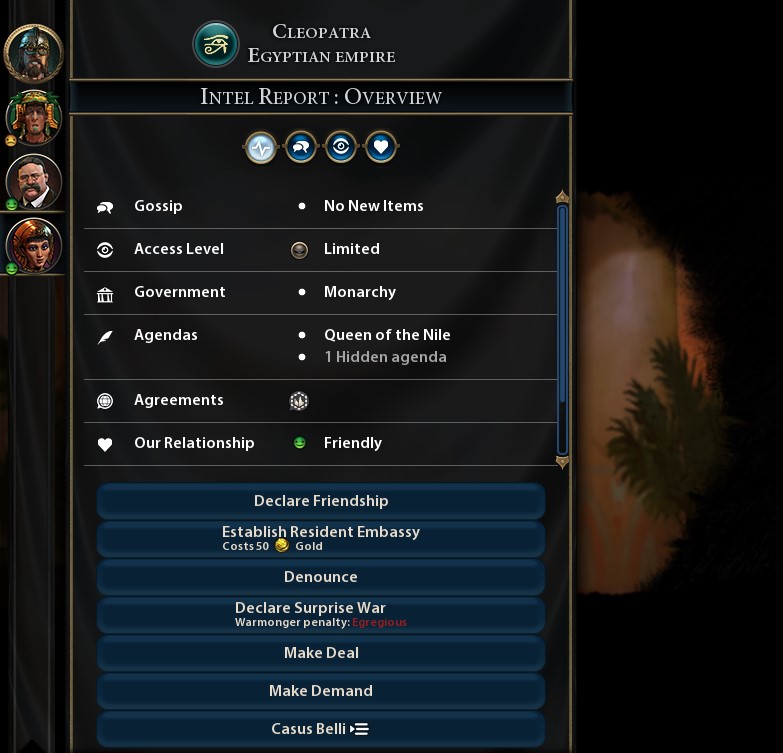
When you engage in diplomacy with civilizations, you will have a number of options available, depending on your current relationship. This screen will also provide important information about your relationship, as well as the latest gossip about what that leader has been doing.
You may choose to declare war, or denounce the leader. You may also negotiate a trade deal, or demand stuff from another civilization. You can also propose friendship, defensive pacts, and send delegations.
DIPLOMATIC RELATIONSHIPS
Every other leader in the game has an opinion of you. Their opinion might be positive or it might be negative; it is in constant flux from events in the game. You can tell what your relationship with another leader is by the icon on their leader portrait, or by selecting Our Relationship with that leader on the Diplomacy Panel. The following relationship states exist in the game:
- Allies. When in an Alliance with a leader, you may not declare a formal war on each other, you automatically share Open Borders, you may make Research Agreements and Defensive Pacts, and deals you make with each other are likely to be very favorable. Territory owned by the other civilization in the Alliance is considered ‘Friendly’, allowing the same privileges as your own territory.
- Declared Friend. When you choose to declare your friendship with a leader, you may not declare a formal war on each other, you may make Research Agreements, and deals you make with each other will be more favorable. This relationship state is required to make an Alliance.
- Friendly. This means the leader thinks positively of you and you have a better chance of getting favorable deals with them.
- Neutral. You have done nothing to upset or impress the leader, and your interactions with them will be standard.
- Unfriendly. For some reason, you have done something to upset this leader, and deals with them will likely be unfavorable for you, or you can choose to make demands of them.
- Denounced. This leader has let the other leaders in the world know that you have done something to offend them. Your deals with them will be unfavorable if they will make them at all, but you can declare a Formal War against them and make demands.
- At War. Open hostilities have broken out between you, and you can attack or invade this leader but you will accrue warmongering and war weariness penalties.
TRADE, DEMAND, AND DISCUSS
You can make trade deals with other players by selecting Make Deal from the Diplomacy Panel with a leader selected. You will enter a negotiation table with that leader.
On the left of the table are items you are able to trade, and on the right of the table are items the other player has available to trade. You can trade anything from Gold to resources to cities! Select items from the other leader’s side of the table to request they trade them to you, and select items from your side of the table to offer in exchange.
When the other leader finds the deal acceptable, an “Accept Deal” button will appear, which will confirm the trade that is on the table. You will lose any items you proposed and gain any items from the other leader.
If the leader does not like the deal, you can select the “Make this deal more equitable” button to cause the leader to propose a deal they believe is fair. You may then adjust their offer to suit your needs, and see if they accept. You can also ask the leader for something and select “What would it take?” to see what they want from you in trade.
If you propose an item but do not ask anything in return, you can select “Give Gift” to give the item to the leader for free. Who doesn’t like gifts? Or you can select “What would you give me?” to ask the leader what they would be willing to pay.
If you are Unfriendly with a leader or either of you has Denounced each other, you will see the Make Demand option on the Diplomacy Panel with that leader selected. This option will take you to a negotiation table, but your side of the table will be blank. Instead, you select items from their side of the table to demand as tribute! Select “Demand Deal” to see if they will pay you what you ask. The leader may not take kindly to your demands.
Whether making a Deal or a Demand, some items are given permanently and some are only loaned to the leader. Sums of Gold, Great Works, Relics, Artifacts, and captured Spies are all permanent trades once you give those items away, you have to trade again to get them back. Resources and gold per turn, however, are temporary, and once the deal has run its course you will get them back.
Depending on your interactions with a leader, you might also have the Discuss option on the Diplomacy Panel. Selecting it will show you a list of actions you can ask the leader to promise to stop doing towards you, but only if the leader has already done that action at least once. You can ask them to stop settling new cities near you, to stop spreading their religion to you, to stop spying on you, or to stop attacking a City State you are Suzerain of.
All Deals, Demands, and Promises last for 30 turns, at which point they need to be renewed.
DELEGATIONS AND EMBASSIES
Delegations and Resident Embassies can be established between players to improve relations and gain Diplomatic Visibility.
A Delegation, or Embassy, needs to be sent to every leader individually. Delegations cost 10 Gold and Embassies cost 25 Gold, which is paid to the other leader. This will give you a small positive bonus in your relationship with that leader. It also gives you 1 level of Diplomatic Visibility. See the Diplomatic Visibility and Gossip section of the Civilopedia for more information on Diplomatic Visibility.
Resident Embassies are unlocked with the Diplomatic Service Civic, at which point they replace Delegations. The effects of Resident Embassies and Delegations do not stack.
OPEN BORDERS
Open Borders is an agreement with another leader to allow them to move their units, military or civilian, through your territory. Without this agreement, entering another leader’s territory is an act of war, except with Religious Units, who can ignore borders entirely. If you have Open Borders with a leader, their border will appear as a dotted line instead of a solid one. Open Borders is unlocked with the Early Empire Civic. Prior to that, your borders are open to everyone.
Open Borders can be offered as part of a Deal trade agreement if both parties have researched the Early Empire Civic, but it is offered individually by each leader-you can be granted Open Borders with a leader without granting them Open Borders in return. The deal lasts for 30 turns, and then it needs to be renewed.
If you are in an Alliance with another leader, you both grant each other Open Borders automatically.
RESEARCH AGREEMENTS
Two allied or declared friendly players can enter into a Research Agreement to get a tech boost for a chosen tech, if both players have researched Scientific Theory. As a part of forming this deal, a specific technology must be agreed upon. The number of turns it will take to complete the research will depend on the current research rates of both users. If either player earns the boost or tech by any other means, the agreement ends and the other player will get the boost immediately.
DEFENSIVE PACT
A Defensive Pact is an agreement between two leaders to come to each other’s aid when targeted by a Declaration of War. It is unlocked by the Mobilization Civic, and both partners must possess this Civic in order to create a Defensive Pact. If either member of the Defensive Pact is targeted, the other member will also declare war against the aggressor. Defensive Pacts are available through the Make Deal negotiation table. The two leaders must be in an Alliance to make the deal.
JOINT WAR
After researching the civic Foreign Trade, a Joint War may be proposed between players who have researched Foreign Trade. If you accept or propose a Joint War, you and another player will immediately be at war with the target player as set in the deal parameters.
TERRITORY
Diplomatic Territory is divided into 3 types:
- Friendly: Territory owned by your civilization. Friendly territory can also be established by becoming allies with a major civilization, or by becoming the Suzerain of a city-state. Units will heal faster in territory that is friendly to them, as well as take advantage of special abilities and policies associated with friendly territory. Units must be in friendly territory in order to be upgraded.
- Neutral: Territory that is not currently owned by a civilization or city state. This territory may be claimed by a civilization or a city state, through expansion of city borders or by founding a new city there. With the exception of the Fort and Airstrip improvements, players are not allowed to construct items in neutral territory.
- Rival: Territory that is owned by another civilization or city-state. Players cannot move into a rival’s territory without first establishing Open Borders with that civilization. Unit healing is lowest in rival territory.
CASUS BELLI
Casus Belli represent reasons to go to war where the normal Warmonger penalty for a declaration of war or capturing cities are reduced or eliminated. Once you reach the Renaissance-era civic Diplomatic Service, you may accumulate Casus Belli against other powers. You must Denounce the other power in order to use a Casus Belli against them. See the table below for the conditions for each Casus Belli, the civic that unlocks them, and the percentage of the usual warmonger penalty that is applied.
- Holy War: If one of your cities is converted to the enemy’s religion (Diplomatic Service, 50% warmongering)
- War of Liberation: If a friend or ally had cities conquered (Diplomatic Service, no warmongering penalty when liberating cities that have been conquered)
- War of Reconquest: If you had cities conquered in a previous war (Defensive Tactics, no warmongering penalty when retaking your previous cities)
- Protectorate War: if a city-state you are Suzerain of is attacked (Defensive Tactics, no warmongering penalty when liberating a city-state target)
- Colonial War: if target civilization is two eras behind you in technology (Nationalism, 50% warmongering)
- War of Territorial Expansion: if target civilization borders your nation (Mobilization, 75% warmongering)
AGENDAS
Diplomatic Agendas are a major driving force in your relationship with other leaders. They drive the desires and behavior of those leaders. You can use Agendas to know how to get on a leader’s good side, or what to do to avoid making them angry.
Leaders have a Historic Agenda and a Hidden Agenda. The Historic Agenda is based on that leader’s real-world historical personality and achievements. The Hidden Agenda is assigned at beginning of every game, and could be a wide variety of things-maybe they like other civilizations with lots of culture or gold, or maybe they dislike warmongers. Revealing the Hidden Agenda is important to knowing what pleases and displeases a leader. Increase your Diplomatic Visibility with each civilization to find out what their leaders’ Hidden Agendas are.
DIPLOMATIC VISIBILITY AND GOSSIP
Diplomatic Visibility allows you to receive Gossip, information about another player’s actions. You gain more detailed Gossip based on your level of visibility, of which there are 5 levels: None, Limited, Open, Secret, and Top Secret. For example, when you have just met a civilization, you will receive information about their declarations of war, denouncements, friendships, alliances, and when they do something like found a Pantheon or complete a wonder.
If you gain Limited Diplomatic Visibility, you will find out some information about their opinion of you and what government they have. At the Open level, you will have access to that civilization’s diplomatic agendas, their relationships with other civilizations, and know when they have launched an inquisition.
You must accumulate Diplomatic Visibility levels individually for each civilization. Levels may be gained by accumulating various sources of Gossip, including:
- Traders. Establish a Trade Route to a civilization to increase visibility by one level.
- Send a Delegation. Send a Delegation to a civilization to increase visibility by one level. Once Embassies are available, establishing an Embassy will replace this.
- Send a spy on a Listening Post Mission. Performing the Listening Post mission in another civilization’s city increases visibility by one level.
- Forming an Alliance. Alternatively to spying, you can form an alliance with a friendly civilization. These two actions do not add separate Diplomatic Visibility levels – it does no good to spy on your allies!
- Research the Printing Press technology. This will increase your visibility with ALL civilizations by one level.
- Play as Catherine de Medici. She gives France one level of access above normal at all times with civilizations she has met.
SPIES AND ESPIONAGE
Starting in the Renaissance era, Spies will become available. You may earn Spies from certain technologies and civics. They can be built in any city, but they cannot be purchased with Gold or Faith. Spies begin at the Recruit level, and may gain levels from successful offensive operations, or capturing an enemy Spy. Upon reaching level 2, Spies may also earn promotions.
Spies are not moved like other units. They jump from city to city using air, sea, road, or foot travel, each with their own travel time, but they may not move to an ally’s city. Once established in a city, a Spy can be sent to a specific district and begin their mission. Missions include stealing technology boosts, creating rebel units, or simply increasing diplomatic visibility. Each mission takes a certain amount of time, and will have a different outcome. Your Spy may be killed or captured, or maybe he failed his mission but was not detected, or perhaps it was not detected and the mission was a success.
Every civilization can produce 5 Spies. Play as Catherine to earn the ability to produce 6.