Introduction
Combat occurs between two political entities that are at war with each other. A civilization may be at war with another civilization or with a city-state. Barbarians are always at war with all civilizations and city-states.
Declaring War
There are a few ways to declare war. The first requires you move a military unit you control into another civilization’s unit. This will prompt a pop-up message to appear asking if you want to start a war. Alternately, war can be declared in the Diplomacy Window.
Within that window, you will always have the option to make a surprise declaration of war, except against your declared allies. Your civilization will suffer a costly warmongering penalty if you make a surprise declaration of war.
To avoid some of this penalty (but not all), denounce the offending civilization and soon the option to formally declare war will appear in the Diplomacy Window.
War Weariness
Having a nation that is constantly at war will diminish the productivity and happiness of your people. War weariness grows for every battle you fight. This accumulation is worse when those battles occur in foreign territory or when your units are killed. It is worse still if those units are killed by a nuclear weapon, but launching a nuclear weapon yourself is the greatest source of war weariness. All war weariness you accumulate is increased depending on the era and if you declared war without using a Casus Belli.
War weariness is applied to every city you own as a negative Amenity, lowering your city growth and productivity. Having low Amenities for too long can cause rebel partisans to spawn in your cities. These hostile units will attack your units and pillage your tiles and districts.
While war weariness will slowly reduce while you are still at war, it reduces at a greatly increased rate when you are not at war with any player.
Warmongering
Warmongering is more than just a diplomatic consequence; it can be a state of mind, considered a most honorable thing from a certain point of view. It is believed that a soldier in Napoleon’s early days of conquest saw his General and Emperor’s constant warmongering to be of righteous cause! There are, however, some stiff penalties for launching a non-justified, or lack of Casus Belli, war.
A player who launches into a non-Casus Belli war (see the section on Casus Belli under Diplomacy) will start to accumulate diplomatic warmongering penalties from other civilizations that player has come in contact with, on top of any war weariness already suffered. Launching a surprise war, capturing opposing civilizations cities, razing captured cities, and using nuclear devices increases the diplomatic penalty based on what era the player is in.
The other approach is to denounce the opposing civilization first and then declare war formally. With this avenue to war, the warmonger penalties are NOT increased and there is the opportunity to use a Casus Belli to reduce those penalties. However, because you must first denounce your opponent, such a plan is “telegraphed” for the target and you will not have the advantage of surprise.
Ending a War
Wars can end violently or peacefully. A war ends violently when one side is destroyed. This occurs when that side has lost its last city. The peaceful resolution of a war involves diplomatic negotiations. You or your opponent may initiate a Peace Deal. See the section on Diplomacy for further details.
Barbarians will never negotiate. War with Barbarians will continue until the Barbarians are destroyed.
Unit Combat Statistics
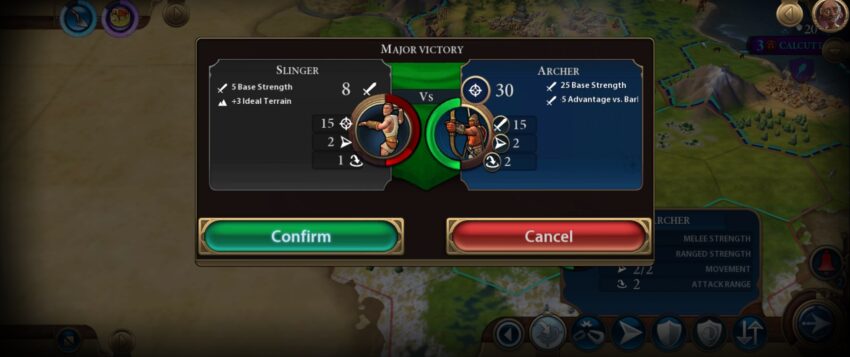
In Civilization VI, military units have five combat oriented stats: Hit Points, Combat Strength, Ranged Strength, Bombard Strength, and Range.
All units have 100 Hit Points. As a unit takes damage, it loses Hit Points. A unit is destroyed once it loses all of its Hit Points.
All military units have Combat Strength. Melee units use their Combat Strength when attacking or defending. Ranged units use their Combat Strength when defending.
Any unit that can engage in ranged combat has a
Ranged Strength statistic. This number is compared with the target’s Combat Strength to determine the results of the attack. Land units with a Ranged Strength can also attack district defenses but at a reduced effectiveness.
Bombard Strength is the anti-district strength of a unit. Units with Bombard Strength can also attack units, but at a reduced effectiveness. Land units cannot have both a Bombard and Ranged Strength, but naval units essentially function as both Bombard and Ranged units.
The unit’s Range stat determines the distance at which a unit can launch a ranged attack. A 2 Range of “2” means that the target can be in an adjacent tile or one tile distant. A Range of “1” would mean that the target had to be adjacent to the attacker.
Some units have an anti-air combat value. These units automatically defend against air attacks within their anti-aircraft range. The anti-air strength is used to evaluate combat with the attacking aircraft.
Line of Sight
Generally, there must be no obstructions, such as a Mountain, between a ranged unit and its target. Units on Hills or flying can often see over obstructing terrain.
Combat Bonuses
Warfare is not practiced by just the experienced and well equipped. Military history has shown time and time again that the combatant, using superior tactics, leadership, and the terrain to their advantage can defeat a numerically superior and better equipped force. In Civilization VI, it is no different.
In combining your military might with the right force organization of combined arms, leadership, and intuitive use of terrain you can have the power to destroy your enemies armies, no matter how big or small, advanced or not. Using terrain to your advantage, you can position your forces on Hills, in Rainforests or Woods, and across Rivers from your enemy to ensure a distinct defensive advantage. Looking at the enemies movements across terrain as they approach you can also help you better understand what their battle plan is or where they look to strike.
Terrain can also be detrimental to your fight; be sure to avoid fighting on Flood Plains and Marshes as these have a negative effect on your defensibility. If you find yourself on indefensible terrain, and do not feel you can defeat your enemy on the attack, perhaps building a few Forts will help you push back the enemy. Remember to attack the enemy’s flanks, it is their weakest point and will also grant you advantage! Using a well-rounded military force with the proper terrain dispositions while having the use of a Great General will ensure victory!
Flanking and Support bonuses: Outmaneuvering the enemy as well as making sure units in the field are supported by their counterparts is important in order to insure victory in the field. In Civilization VI we simulate this with the Flanking and Support bonuses.
Once a player has completed the Military Tradition civic, their military is considered advanced enough in order to benefit from these bonuses.
Flanking: If an enemy melee unit is surrounded by 2 or more adjacent friendly melee units during an attack, it is considered flanked, granting a +2 combat bonus to the melee attacker for each additional flanking melee unit.
Support: When defending against an enemy melee attack, a defending unit can gain a +2 combat bonus for every adjacent friendly unit.
Experience and Promotion
A unit that survives combat or discovers a Tribal Village will gain “Experience Points” (XP). Once a unit reaches a certain amount of XP it will ‘level up’, at which point it can receive a promotion.
Promotions enhance the unit in some way. When selecting a promotion, the unit is healed an amount of Hit Points. The unit will not continue to gain any further XP until the promotion is selected.
City Combat
Cities may be attacked and captured by military units. Each city has a “City Combat Strength” stat that determines its strength when attacked by other units. The higher the city’s City Combat Strength, the more difficult it is to capture the city. Unless the city is extremely weak or the attacking unit is extremely strong, it will take multiple turns to capture a city.
Walls add extra protection to a city or Encampment, making it even more difficult to conquer. This protection is like armor, shielding the city from attacks. Melee units deal only 15% of their normal damage to walls, and ranged units deal only 50% of their normal damage.
Only Bombard units deal 100% of their normal damage to walls, making them necessary to capture a fortified city. If the walls are damaged, they stop being as effective and the district’s health will start taking a little bit of damage with every attack. Walls can only recover health with a Project found in the city’s Production Queue, like repairing district buildings, that becomes available if the district has not taken any damage for 3 consecutive turns.
Once a city has walls, it can make ranged attacks against enemy units using a “City Ranged Strength” stat.
The City Combat Strength is based on the the
Combat Strength of the strongest melee unit built by your civilization, minus 10, or by Combat Strength of a garrisoned military unit.
The City Ranged Strength is based on the Ranged Strength of the strongest ranged unit built by your civilization.
The city gets additional bonuses to its City Combat Strength for each non-pillaged district it has, making big cities harder to capture, and from terrain and a few other modifiers sources.
Cities can also be under siege from attacking units. The City Center and other defensible districts like the Encampment are considered under siege if all 6 tiles around them are occupied by enemy units, under enemy Zone of Control, or are impassable due to mountains or Natural Wonders.
In these circumstances, the district will not recover lost health, instead of healing automatically every turn as normal.
Conquering a City
When your unit enters an enemy city, you have two choices: you can destroy the city (if it was not a
Capital) or you can annex it and make it part of your empire. If that city once belonged to another civilization, you may also chose to liberate it to its original owner.
Formations
Formations allow you to easily move units together. This can be useful for escorting civilian units in hostile lands, or even creating stronger units in Corps and Armies. A military unit can create a formation with a support or civilian unit at any time. Naval military units may also create a formation with embarked land units. Support units, such as siege units, are most effective in battle when linked with another military unit.
Starting in the Industrial era after completing the Nationalism civic, players will be able to unlock the ability to combine multiple military units of the same type into a single stronger unit. Two military units of the same type will be able to combine to create a Corps, giving them +10 to their base Combat Strength.
After researching Mobilization, three units of the same type may be combined into an Army, giving +7 to their base Combat Strength. Keep in mind that their HP is NOT increased when units are
combined in this way.
Once a Corps or Army has been formed, the units may not be broken apart into individual units again. The experience and promotions of the highest experience unit is preserved when creating this type of formation, so it is beneficial to combine rookies with more experienced units. Naval units may also be combined into Fleets and Armadas.
Pillaging
Both improvements and buildings in districts without garrisons can be pillaged. This action renders them inoperable and awards the pillaging unit with some form of “plunder.” With the exception of healing, these plunder awards increase in magnitude as you progress through the game.
Pillaging a district takes 3 Movement Points, or all of your movement. Each building in a district must be pillaged separately, and awards some sort of plunder based on the district. Refer to the district’s page for specific yields. Once pillaged, a building cannot be pillaged again until it is brought back online by its owner (done through the Production Menu and takes 25% of the Production cost of initial construction of that building.)
Pillaging an improvement will take 3 Movement Points, or all your movement (if you have Movement Points of less than 3). It will mark the improvement in the tile as “pillaged”. Once pillaged, an improvement cannot be pillaged again until it is brought back online by its owner (a Builder operation that always takes one turn but does not require a Builder charge). Refer to the improvement’s page for specific yields.